Via Maryland Today / By Annie Krakower
Students Choose, Pitch, Vote for Causes to Support With Mini Do Good Grants
Mia Owens ’28 was spending the summer with her grandparents as an 8-year-old when her grandma unexpectedly shook her awake early one weekday morning. They’d be going to church—something Owens considered a weekend activity—not for services, but to volunteer at a food pantry.
“That experience changed my life and opened my eyes to very startling realities” about hunger in her community, she told a classroom of her fellow Terps last week. “We can help take a step toward eliminating that issue.”
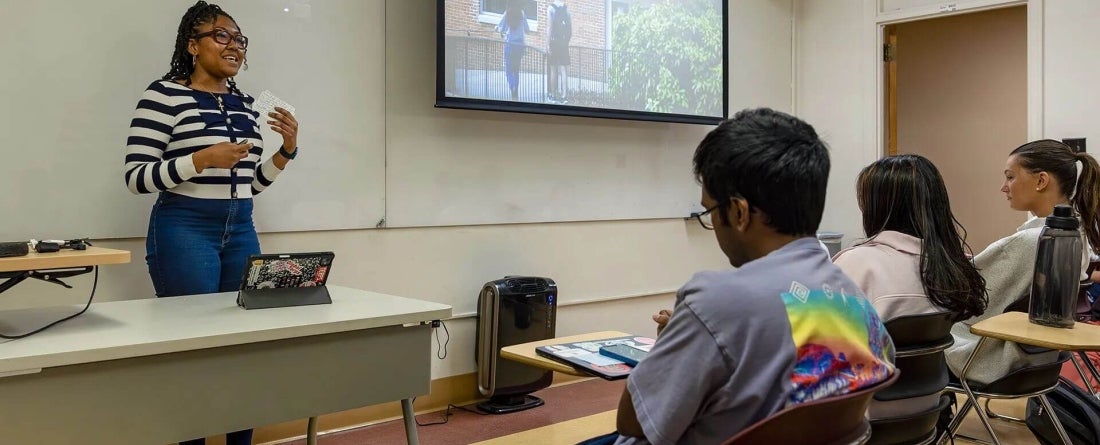
It was part of Owens’ emotional appeal during her “Oral Communication: Principles and Practices” (COMM107) class as she drummed up support for UMD’s Campus Pantry, which distributes food to Terps in need. She’s one of nearly 2,000 students pitching causes they care about this spring, thanks to an expanded collaboration between the College of Arts and Humanities’ Department of Communication and the Do Good Institute (DGI).
Students across the general education course’s 99 sections all selected and researched a social impact organization to highlight in a six-minute call-to-action speech, persuading their classmates to support it. Now, as Terps across sections complete their presentations, they’ll vote on the most convincing proposal, with each winning organization receiving a $150 mini-grant from the Do Good Institute.
“Through this partnership, students are really gaining confidence in their skills and seeing how oral communication can drive social impact and civic engagement,” said Melissa Lucas, associate clinical professor and co-director of the oral communication program in the Department of Communication.
Though the department and the Do Good Institute had been piloting this idea for a few years, this academic year was the first time the experience was offered for all COMM107 sections in the fall, winter and spring. Students used techniques from the class to prep their pitches, “bringing together all of what they’ve learned about the best practices for delivery, for crafting an argument and for ethically communicating with an audience,” Lucas said.
That included persuasive strategies like using the rhetorical concepts of ethos (an appeal to credibility), logos (logic) and pathos (emotion) to connect with the audience in different ways, or inviting listeners to visualize the issues and impact through examples. Brainstorming and outlining workshops helped students sharpen their speeches.
“I think it’s really important to be able to highlight some of the important work that people across campus do to address social issues that we have,” said Sai Divvela ’27, who presented about the Accessible Prosthetics Initiative, a student club that builds low-cost, 3D-printed limb replacements.
While instructors provided a guide of local, Terp-owned or campus organizations, students could select any cause they felt passionate about. Popular ones have included UMD’s chapter of the Food Recovery Network, which collects surplus food from around campus to donate to pantries and other nonprofits; UMD’s chapter of Engineers Without Borders, which partners with disadvantaged communities to implement sustainable engineering projects, like bridges and solar panels; and the nonprofit There Goes My Hero, which provides a support system for blood cancer patients.
But other students have ventured out, advocating for, say, the Second-hand Serpents Reptile Rescue—a winner last fall.
“There are some really fun one-offs that you maybe wouldn’t expect,” said communication Lecturer and Manager Taylor Kleiner. “Even for the students that aren’t the winners in their section, they get to learn about so many organizations: I had ones about bunny rabbits in my class, ones about Rubik’s Cubes.”
The grants for the winners will be available before the end of the semester. With that clear outside-the-classroom impact, both the communication department and the Do Good Institute hope to continue the partnership in the future.
“It’s a great way to introduce students to the concept of the University of Maryland as a Do Good campus, and for them to think of the real-world implications of the work that they’re doing,” said Katlin Gray, Do Good Institute lecturer and senior program manager.